| Els arciorgani i arcicembali
són instruments de teclat amb tecles addicionals que permeten ampliar
en un nombre variable de graus usables en el sistema mesotònic.
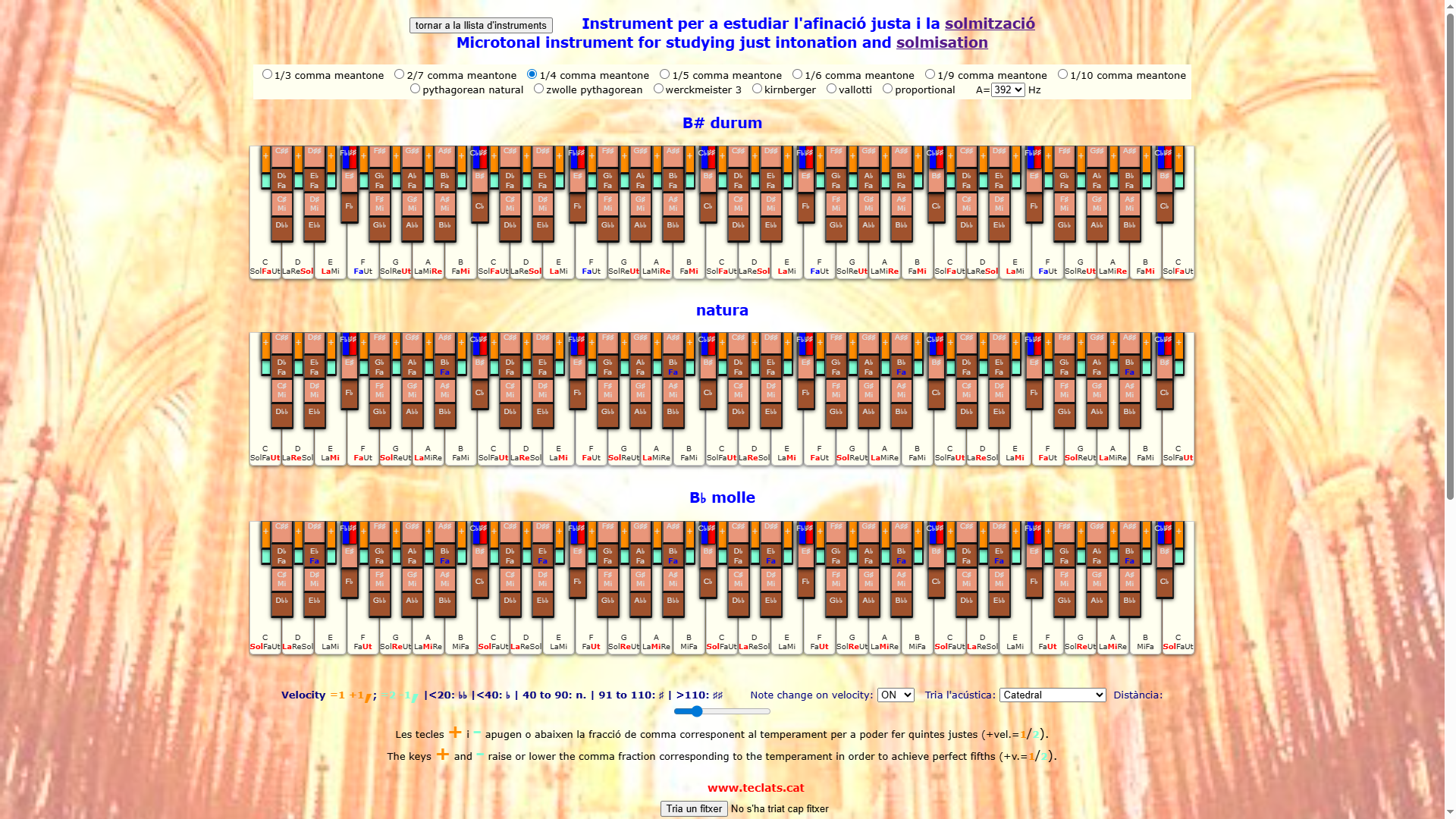
Tot i que aquesta interfície ofereix diversos sistemes de temperament per a altres usos, la seva funció principal està centrada en el mesotònic de 1/4 de comma. Ultra les funcions pròpies de l'afinació justa i de les possibilitats cromàtiques i enharmòniques, la interfície disposa de tres teclats que, tot i adreçar les mateixes notes i els mateixos sons, ho fan emprant la nomenclatura solmitzada introduïda per Guido d'Arezzo. Per a adreçar les tres propietats de l'hexacord i dirigir-los als teclats i sons corresponents mitjançant MIDI s'usa el canal 1 per a la propietat de natura, el canal 2 per a B durum, i el canal 3 per a B molle. Aquesta eina ha estat dissenyada inspirant-se de manera lliure en referències històriques. En particular, la disposició de les tecles accidentals addicionals no segueix la disposició tradicional, sinó un sistema progressiu. Les mostres sonores emprades provenen de diverses fonts: el flautat d'orgue correspon a l'orgue Molero del Museu de la Música de Barcelona i els xantres han estat generats amb l'aplicació de síntesi vocal Synthesizer V. L'harmonització d'aquests sons cerca aproximar-se, en l'esperit, a una estètica pròpia del segle XVI: rigor, presència i estructura. La veu aquí no interpreta, sinó que representa, allunyant-se de criteris expressius desenvolupats en contextos històrics posteriors, que no sempre són pertinents per a aquest repertori. --- Per poder adreçar mitjançant MIDI les tecles addicionals, i així permetre la reproducció de peces polifòniques, es fa ús del paràmetre de velocity. Si el valor de velocity és entre 40 i 90, la nota adreçada correspon a la que es tocaria en un instrument històric de 12 tecles per octava (amb C#, E♭, F#, G# i B♭). Amb velocity entre 91 i 110, s'adreça la tecla corresponent al sostingut (#) del número MIDI indicat; amb velocity superior a 110, el doble sostingut (##), sempre dins del temperament seleccionat. Paral·lelament, amb velocity entre 20 i 39 s'adreça el bemoll (♭) corresponent, i amb velocity entre 5 i 19 el doble bemoll (♭♭). A més, hi ha dos valors de velocity més: velocity 2 i 1, que corresponen a les tecles de color verd clar i taronja del teclat. Aquestes actuen sobre la mateixa tecla sobre la qual estan col·locades, rebaixant l'afinació en el primer cas i apujant-la en el segon, segons la fracció de comma corresponent a la quinta en el temperament seleccionat. En el cas típic del mesotònic de quart de comma, això representa un quart de comma amunt o avall, de manera que es poden obtenir quintes pures sense sacrificar les terceres que hi pugui haver. |
The archiorgan and archicembal
are keyboard instruments with additional keys that allow expansion into
a variable number of usable degrees in the meantone system.
Although this interface offers several temperaments for other uses, its main function is focused on the 1/4 comma meantone. Beyond the functions of just intonation and the available chromatic and enharmonic possibilities, the interface provides three keyboards which, although addressing the same pitches and sounds, do so using the solmization nomenclature introduced by Guido of Arezzo. To address the three properties of the hexachord and route them to their corresponding keyboards and sounds via MIDI, channel 1 is used for the natura property, channel 2 for B durum, and channel 3 for B molle. This tool has been designed with free inspiration from historical references. In particular, the arrangement of the additional accidental keys does not follow the traditional layout, but a progressive system. The sound samples used originate from various sources: the organ diapason is taken from the Molero organ at the Museu de la Música de Barcelona and xantres have been generated using the vocal synthesis application Synthesizer V. The harmonization of these sounds seeks to approximate, in spirit, an aesthetic characteristic of the sixteenth century: rigor, presence, and structure. Here, the voice does not interpret but rather represents, distancing itself from expressive criteria developed in later historical contexts, which are not always pertinent to this repertoire. --- To address the additional keys via MIDI, and thus allow the reproduction of polyphonic pieces, the velocity parameter is used. If the velocity value is between 40 and 90, the resulting note corresponds to what would be played on a historical 12-note-per-octave instrument (with C#, E♭, F#, G# and B♭). With a velocity between 91 and 110, the key corresponding to the sharp (#) of the addressed MIDI number is triggered; with a velocity higher than 110, the double sharp (##), always within the selected temperament. In parallel, with a velocity between 20 and 39, the corresponding flat (♭) is addressed, and with a velocity between 5 and 19, the double flat (♭♭). In addition, there are two further velocity values: velocity 2 and 1, which correspond to the light green and orange keys on the keyboard. These affect the same key on which they are placed, lowering the tuning in the first case and raising it in the second, according to the fraction of a comma corresponding to the fifth in the selected temperament. In the typical case of quarter-comma meantone, this represents a quarter of a comma up or down, allowing for pure fifths without sacrificing any thirds that may be present. |
